Case Study

PayGrid

Stablecoin payroll for global contractor payouts.

Contractor Payroll
Primary Use Case
USDC + USDT
Payout Assets
4
Supported Chains
3
Distinct Roles
PayGrid logo
PayGrid
Next.jsReactTypeScriptTailwind CSSNode.js+8 more
PayGrid
Project Overview

About This Project

PayGrid is a stablecoin payroll platform in progress for companies paying international contractors. The product includes USDC/USDT treasury management, multi-chain routing, payout approvals, address checks, contractor onboarding, payment status, audit trails, and operator controls. ChainScore Labs is shaping the product architecture, transaction UX, treasury controls, contractor portal, and implementation foundation.

Client

PayGrid

Timeline

Start
April 2025
Completed
June 2025
Problem Framing and Payout Model
Product Architecture and Roles
Treasury and Transaction UX
Implementation Foundation

Technologies

Next.jsReactTypeScriptTailwind CSSNode.jsPostgreSQLRedisWebSocketsViem / WagmiUSDC / USDTArbitrum / Base / Polygon / SolanaCircle CCTPStargate / Across

The Payroll Problem PayGrid Solves

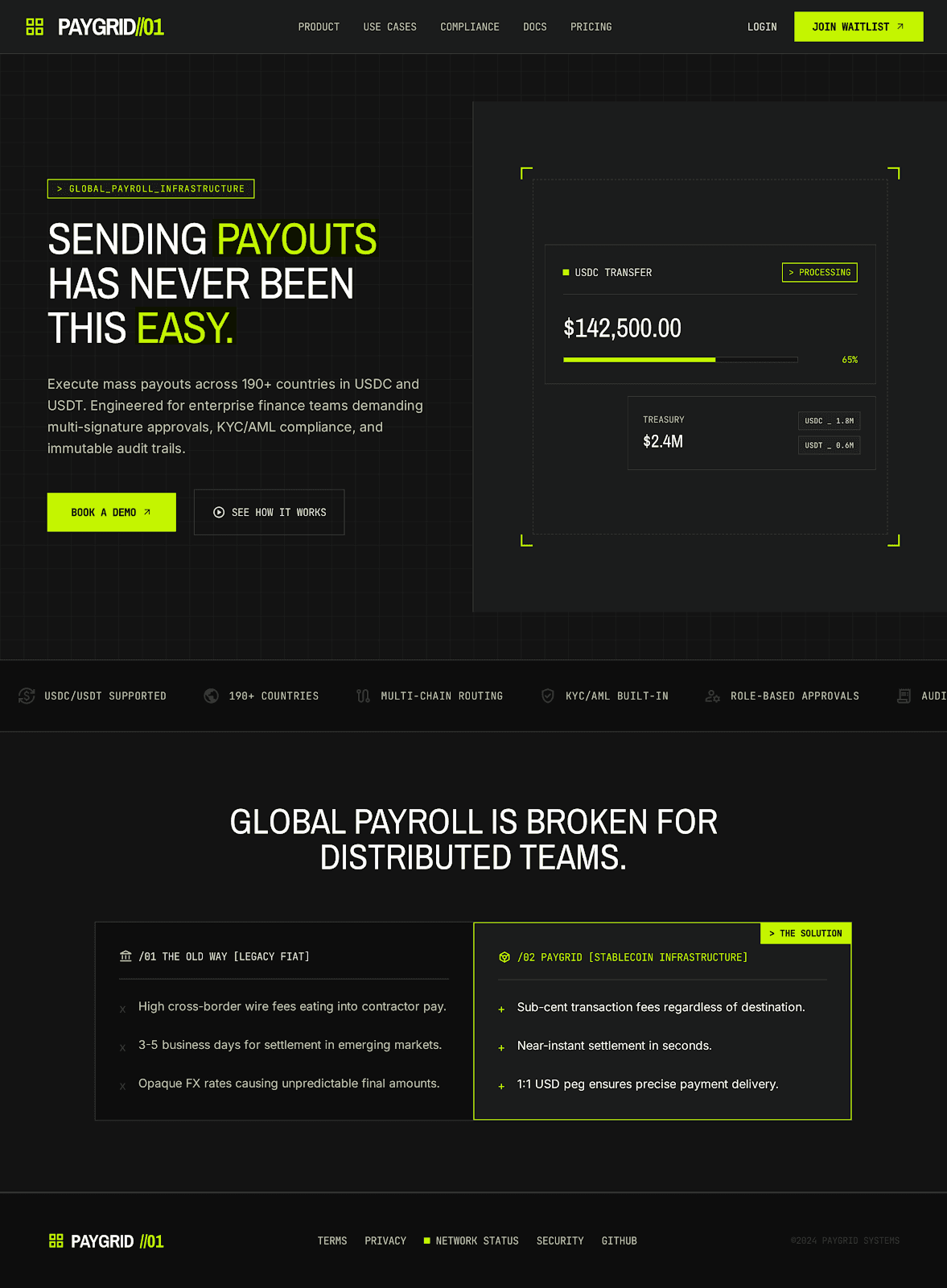
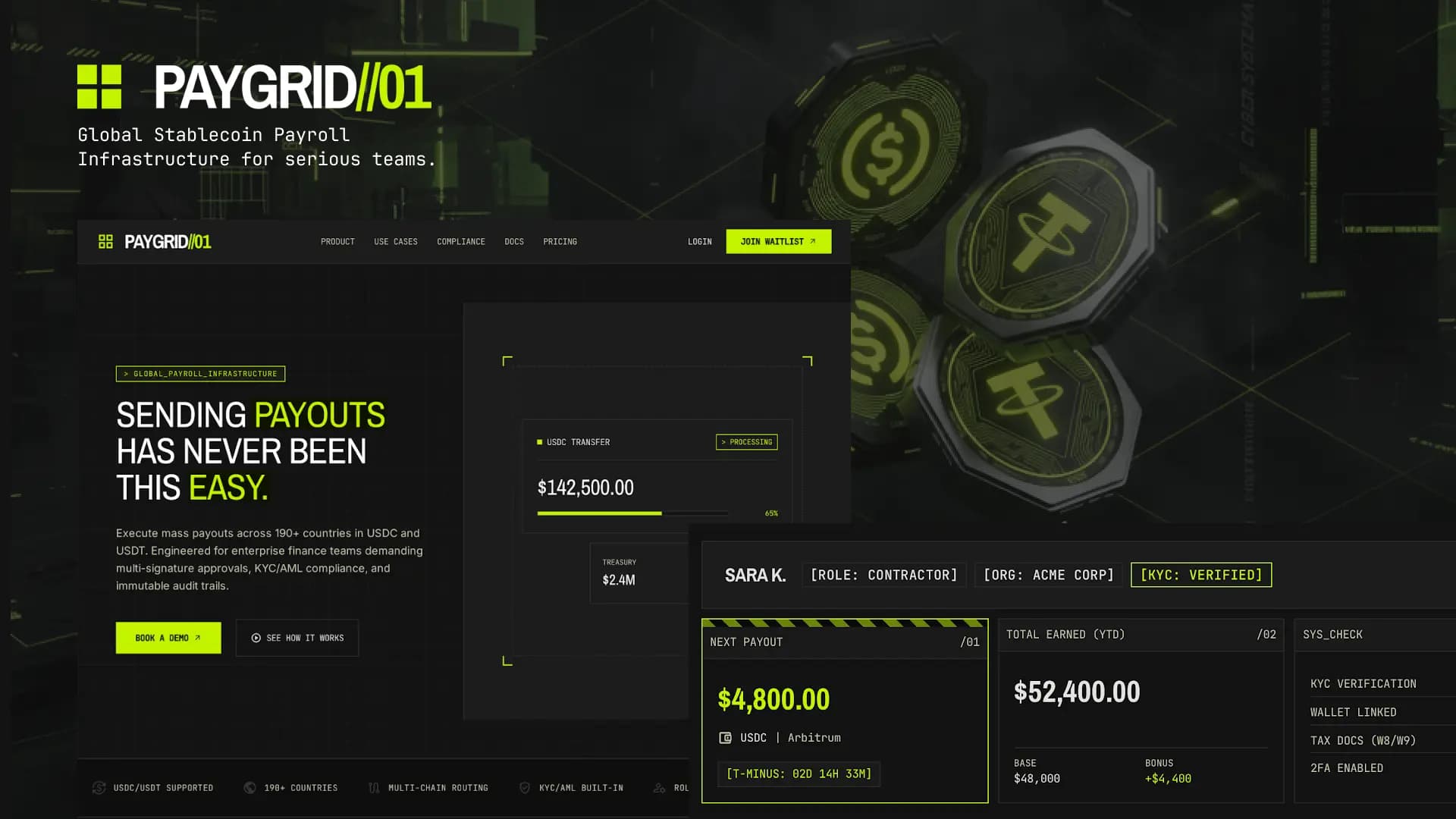
International contractor payroll is still heavy operational work: wire fees, FX spreads, delayed settlement, failed transfers, address collection, and approvals spread across email, spreadsheets, and bank portals. PayGrid treats payroll as a treasury workflow. A company funds a stablecoin treasury, configures contractors and payout rules, routes transfers across the right chain, and records each action in an approval trail.
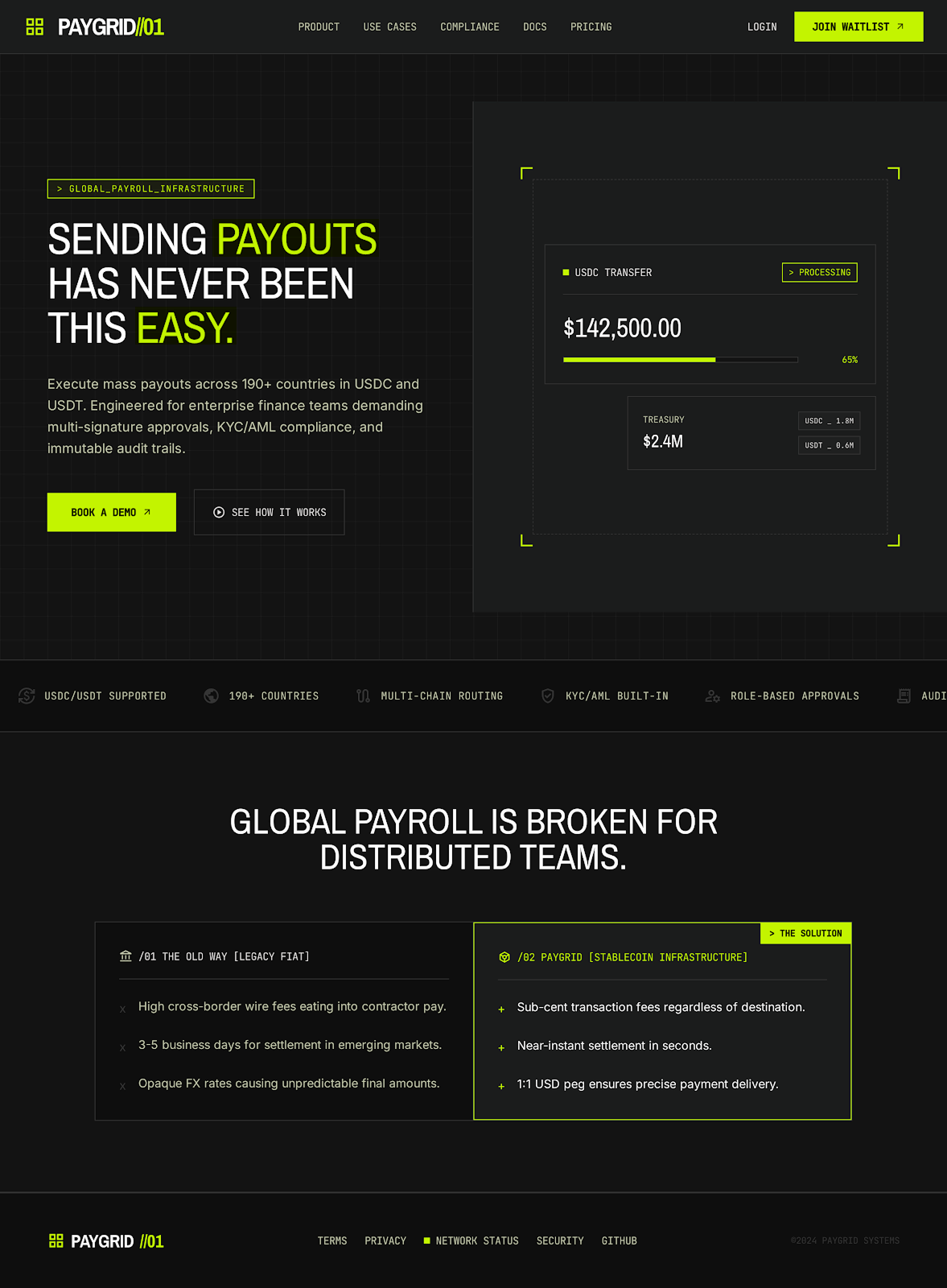
PayGrid landing page introducing stablecoin payroll for global payouts
Treasury, approvals, contractors, and audit state in one workflow

A Payroll Operating Model, Not Just a Send Button

The first product decision was to model PayGrid around roles and state transitions. Admins create the workspace and policy defaults. Finance operators fund treasury wallets, prepare payout runs, and approve high-risk actions. Contractors only see the information they need: verification status, linked wallet, upcoming payout, and payment history. That split keeps the product usable without hiding operational complexity. Payroll moves through explicit states: draft, funded, pre-flight checked, approved, broadcast, confirmed, reconciled, or failed. Each state creates a clear point for validation, logging, and user messaging.
  • Workspace Setup: The onboarding flow captures company details, preferred settlement assets, default chain, and operating policies before any funds move.
  • Role Boundaries: Admins manage configuration, finance operators manage treasury actions, and contractors manage receiver-side readiness.
  • Payout States: Every payout run has a lifecycle that can be audited and resumed instead of being treated as a single opaque transaction.
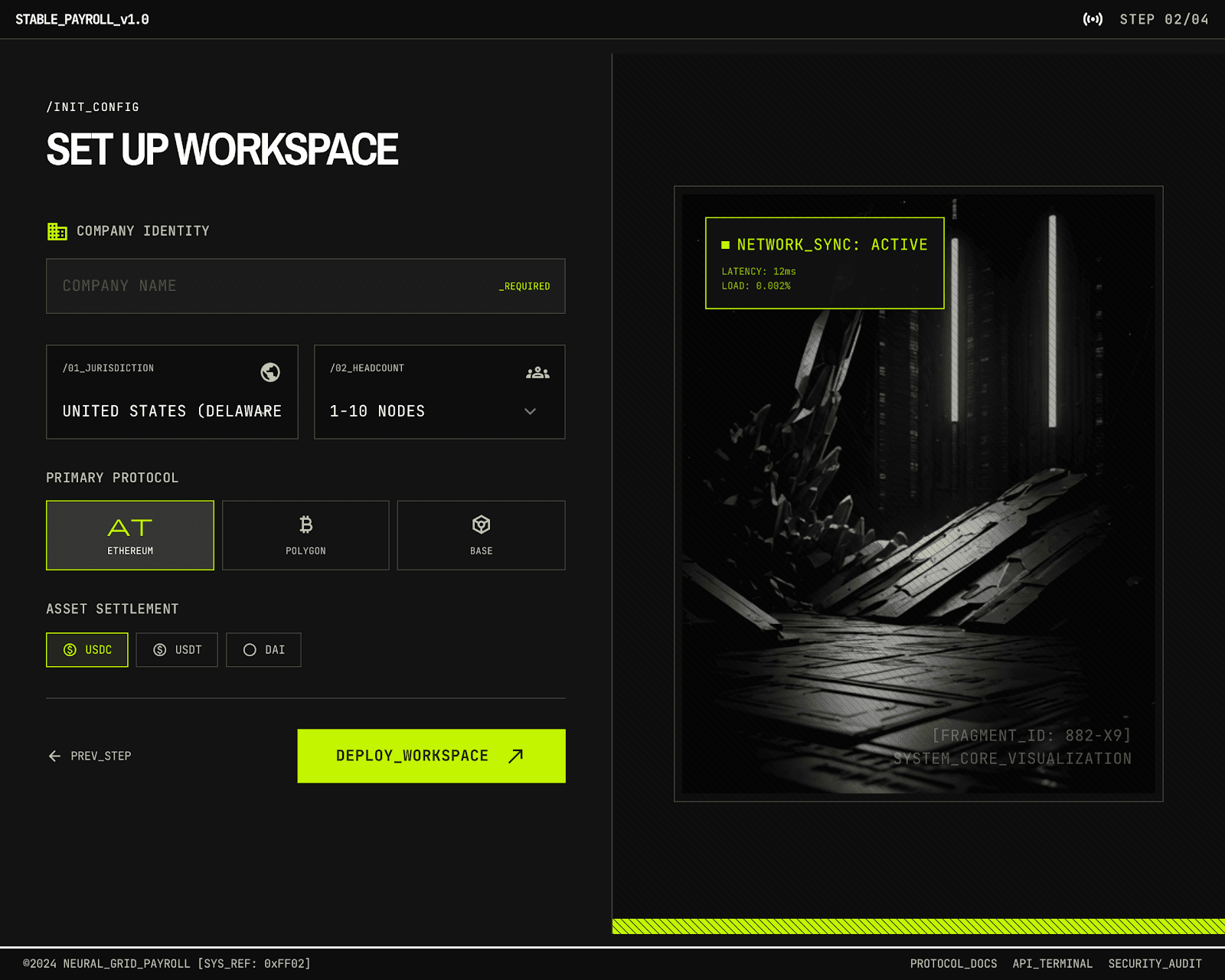
PayGrid admin onboarding flow for workspace and payroll configuration
Keeping liquidity, runway, and risk visible before payroll runs

Treasury Control for Stablecoin Payroll

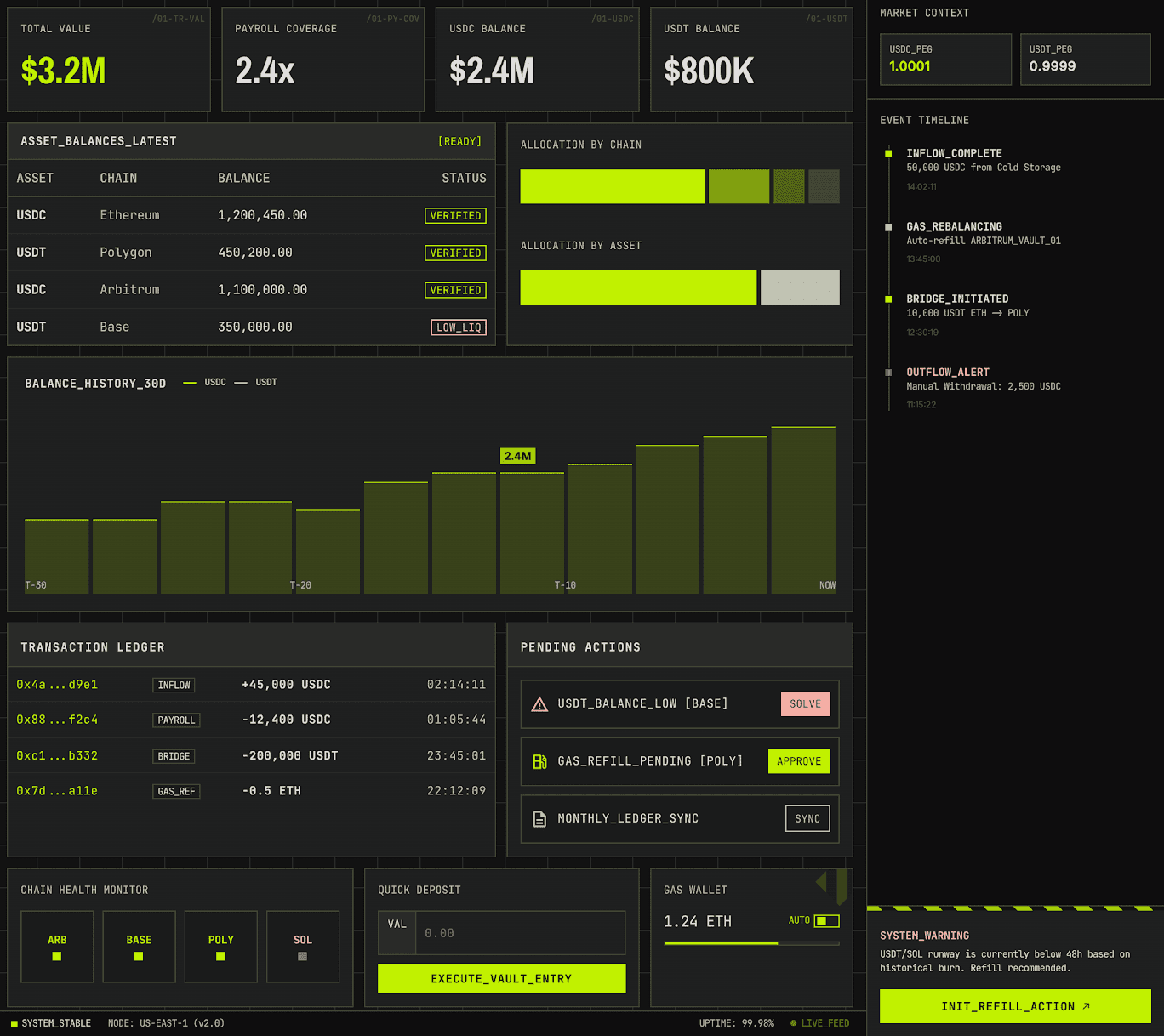
A stablecoin payroll product lives or dies on treasury clarity. PayGrid's admin dashboard and assets view are designed to answer three questions quickly: is there enough balance to run payroll, where is that balance sitting, and what needs attention before funds are sent? Instead of only showing balances, the UI groups treasury data into operating signals: asset split, chain allocation, refill warnings, transaction ledger, pending actions, and system health. That gives finance teams a way to catch liquidity gaps, low gas reserves, stale confirmations, or pending approvals before they become failed payroll events.
  • Balance by Asset and Chain: USDC and USDT balances are shown per network so operators know whether liquidity exists in the right place, not just in aggregate.
  • Runway and Refill Signals: The dashboard can surface whether treasury coverage is enough for the next payroll window and which network needs refilling.
  • Ledger First: Treasury movement is represented as a ledger of deposits, bridges, payouts, withdrawals, and gas operations.
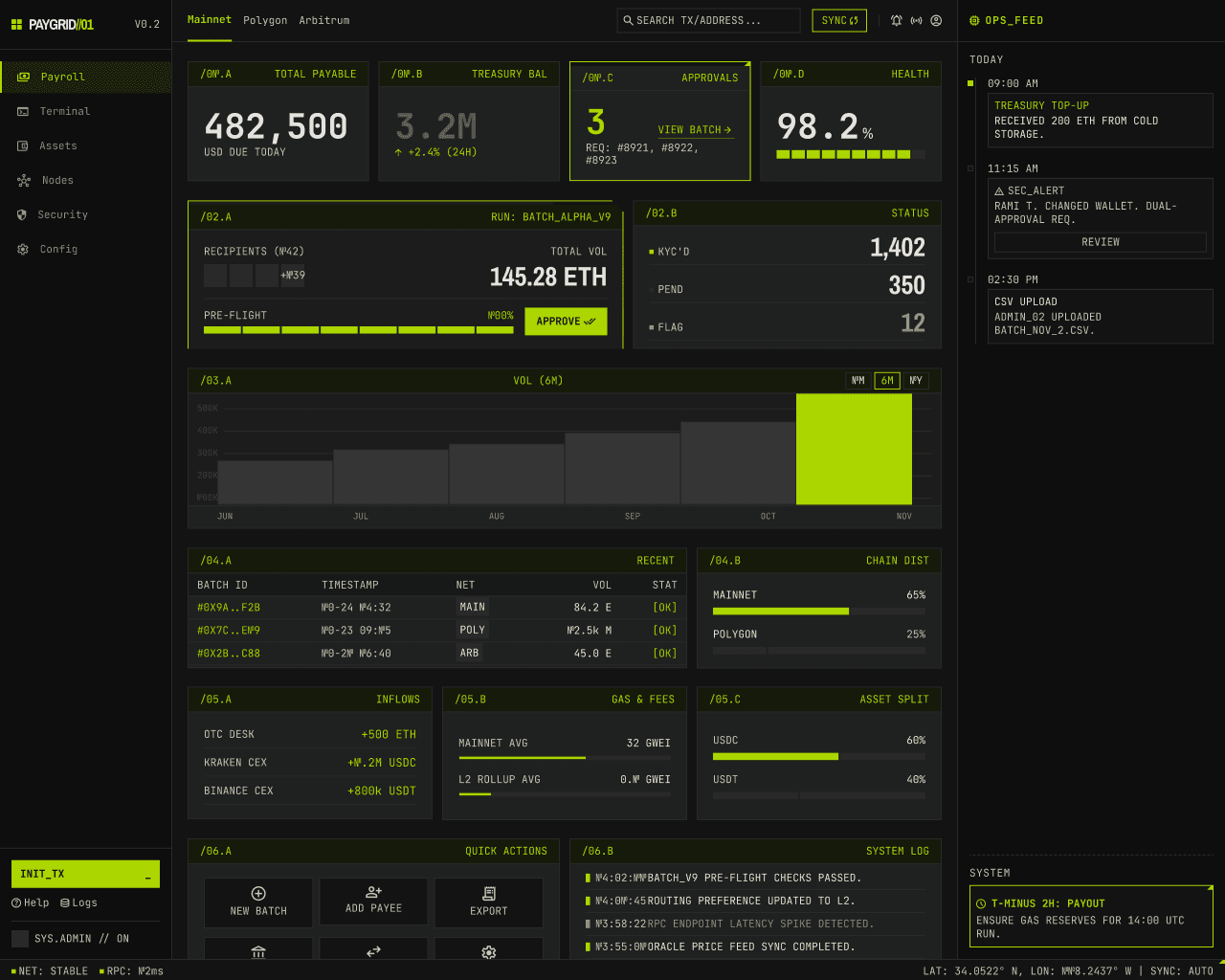
PayGrid admin dashboard with treasury, payout, and system health panels
PayGrid assets dashboard with stablecoin balances and chain allocation
PayGrid admin dashboard with treasury, payout, and system health panels
Pre-flight checks, whitelisted destinations, and review gates

Making High-Risk Transfers Hard to Misfire

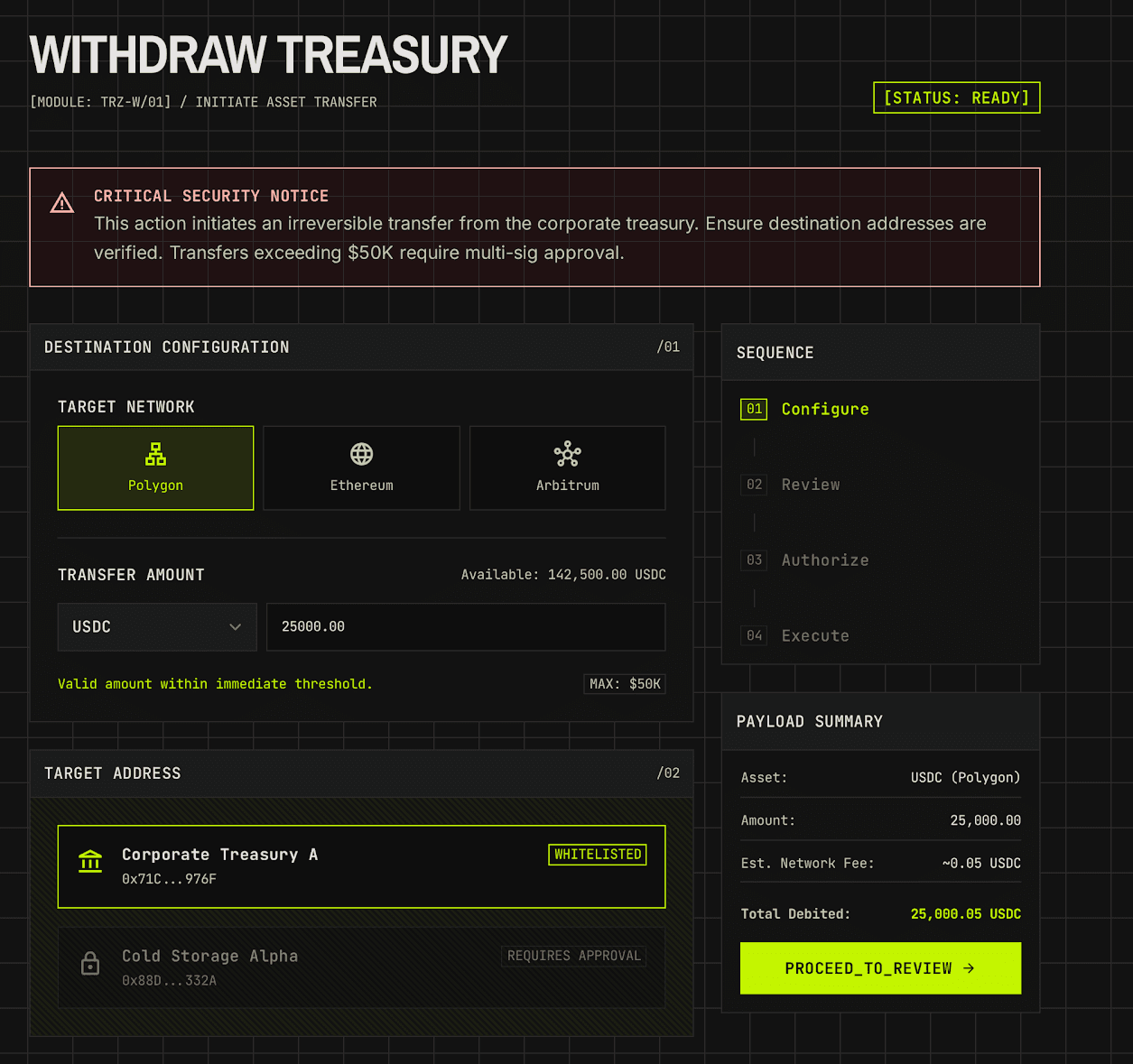
Payroll transfers are operationally sensitive because stablecoin payments are fast and hard to reverse. PayGrid treats funding and withdrawal flows as controlled sequences rather than simple forms. The interface checks wallet state, token approvals, available balance, gas estimates, destination rules, and required approvals before the operator broadcasts anything. The withdrawal flow is intentionally stricter than the funding flow. Destination addresses are selected from whitelisted records, large transfers can require multi-sig approval, and the operator sees the payload summary before moving into review. This reduces fat-finger risk and gives compliance teams a cleaner audit trail.
  • Pre-Flight Validation: Before funds move, the system validates wallet connection, balance, token approval, estimated gas, and settlement path.
  • Whitelisted Destinations: Treasury withdrawals use verified destination records instead of free-form addresses wherever possible.
  • Review Before Broadcast: Operators confirm amount, asset, network, fee estimate, and destination before the transaction reaches the signing step.
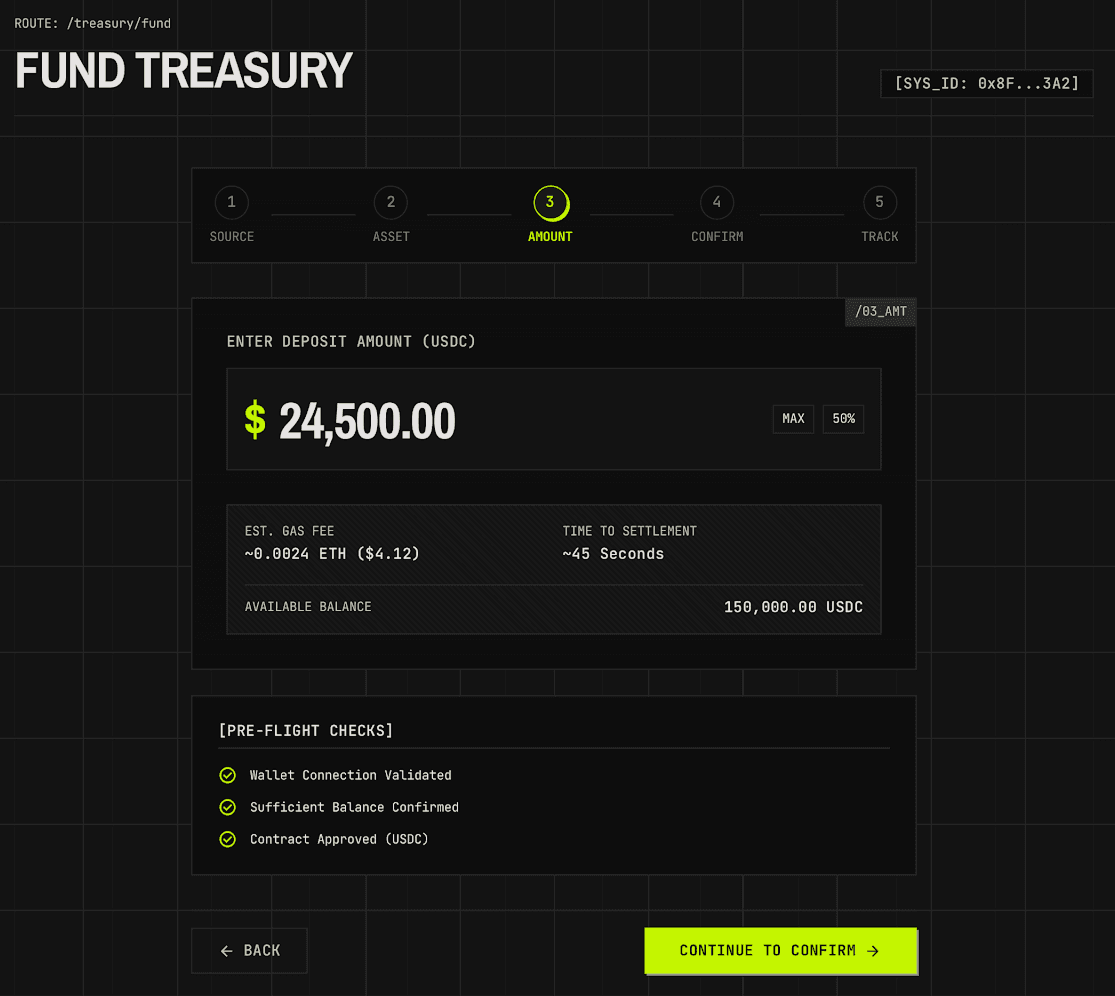
PayGrid fund treasury flow with amount input and pre-flight checks
PayGrid withdraw treasury flow with whitelisted destinations and review sequence
PayGrid fund treasury flow with amount input and pre-flight checks
Fees, speed, network health, and settlement certainty

Cross-Chain Routing Without Hiding the Trade-Offs

The hard part of multi-chain payroll is not showing a chain selector. It is deciding how funds should move when payroll liquidity is on one network and contractors expect settlement on another. PayGrid's bridge view makes that decision explicit by comparing available routes by fee, estimated time, and received amount. The technical model is provider-agnostic. Circle CCTP, Stargate, Across, and native bridge paths can be treated as route candidates. A routing layer can score each candidate by cost, speed, chain support, liquidity, and finality profile. The UI then exposes the trade-off instead of pretending every bridge is the same.
  • Route Candidates: Bridge and transfer providers are normalized into comparable route quotes with fee, ETA, and expected receive amount.
  • Chain Health Context: Routing decisions can account for gas conditions, latency, and sync status before recommending a path.
  • Payroll-Aware Routing: The best route for payroll is not always the cheapest; confirmation reliability and operational timing matter.
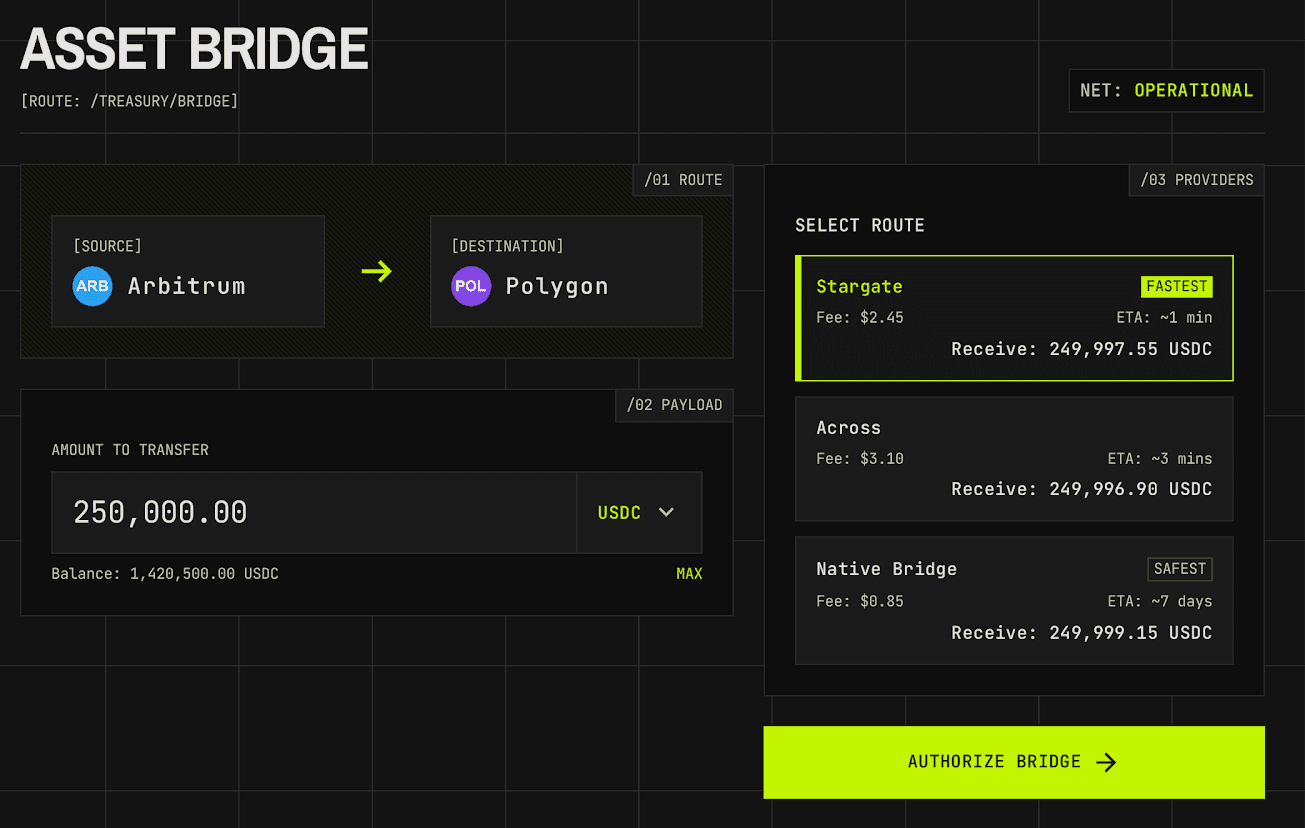
PayGrid asset bridge screen comparing cross-chain stablecoin routes
Rules for refills, gas reserves, and payroll readiness

Automation for Repeated Treasury Work

A finance operator should not manually check the same treasury conditions every day. PayGrid's automation layer is designed around rules: refill a hot wallet when balance drops below a threshold, alert when gas reserves are low, pause a payout run when a destination fails validation, or move excess funds back to cold storage after payroll completes. The important design choice is that automation is observable. Rules have names, statuses, last-run timestamps, execution logs, and failure reasons. This gives teams the efficiency of automation without turning payroll operations into a black box.
  • Trigger Conditions: Balance threshold, payout approval, gas reserve, schedule, and validation-failure triggers.
  • Operator Review: Rules can run automatically, pause for review, or create alerts depending on risk level.
  • Execution Logs: Every rule execution should produce a timestamped event with status, reason, and transaction reference when applicable.
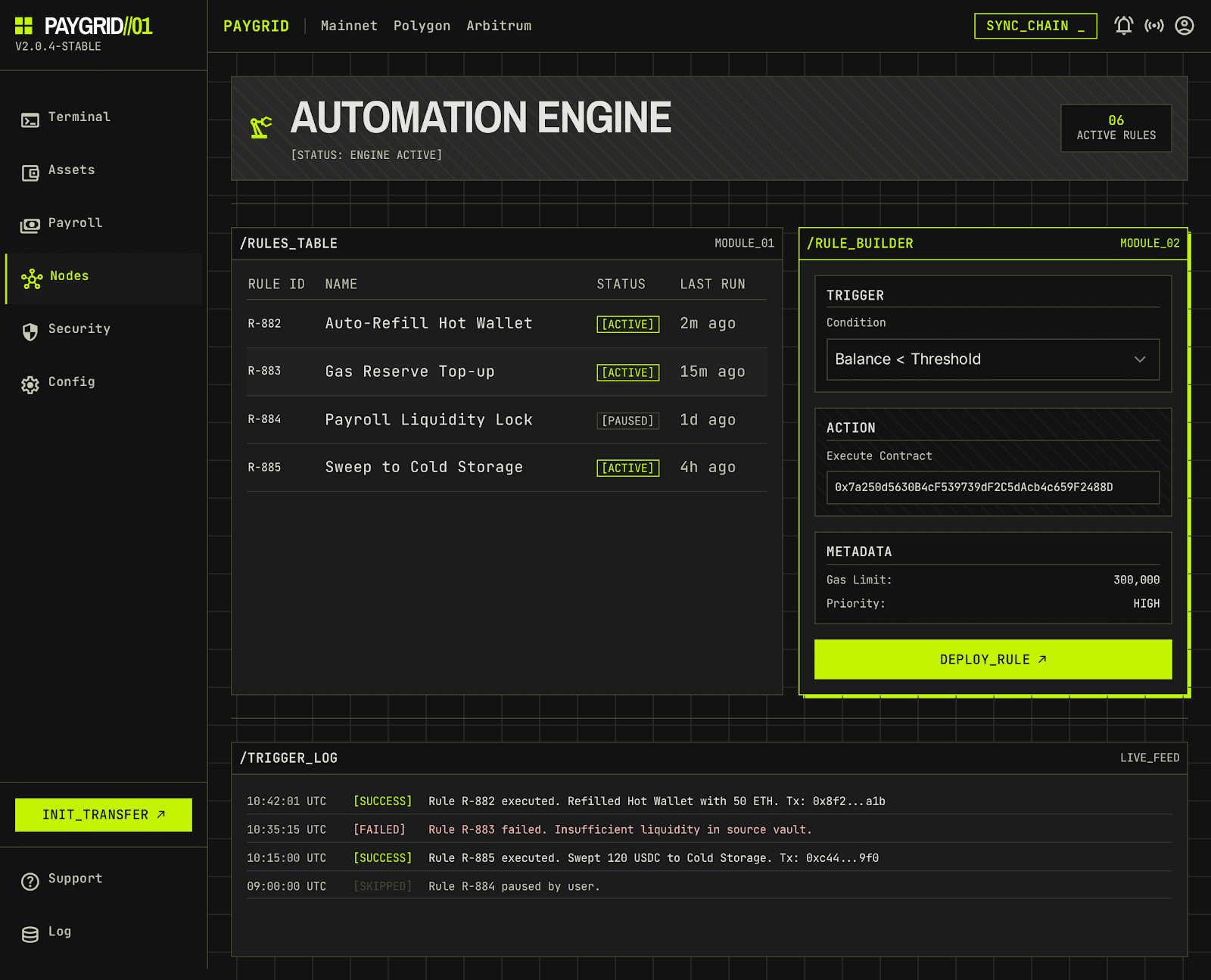
PayGrid automation engine with rules table and trigger log
Receiver-side clarity for wallet, KYC, and upcoming payout state

Contractor Experience: Status Instead of Support Tickets

The contractor portal intentionally does less than the admin product. Contractors do not need a treasury dashboard; they need to know whether they are verified, whether their wallet is linked, when the next payout is expected, and what action is blocking payment if anything is incomplete. This lowers support load for the employer and reduces uncertainty for the contractor. If KYC, tax documents, 2FA, or wallet status needs attention, the portal can show the blocker directly instead of forcing the contractor to ask finance for an update.
  • Receiver Readiness: KYC, wallet, tax docs, and account security are surfaced as simple pass/fail readiness checks.
  • Upcoming Payout: Contractors can see the next payout amount, asset, chain, and timing without seeing internal treasury details.
  • Self-Service Fixes: Action-needed states can route the contractor to the exact missing step, reducing manual coordination.
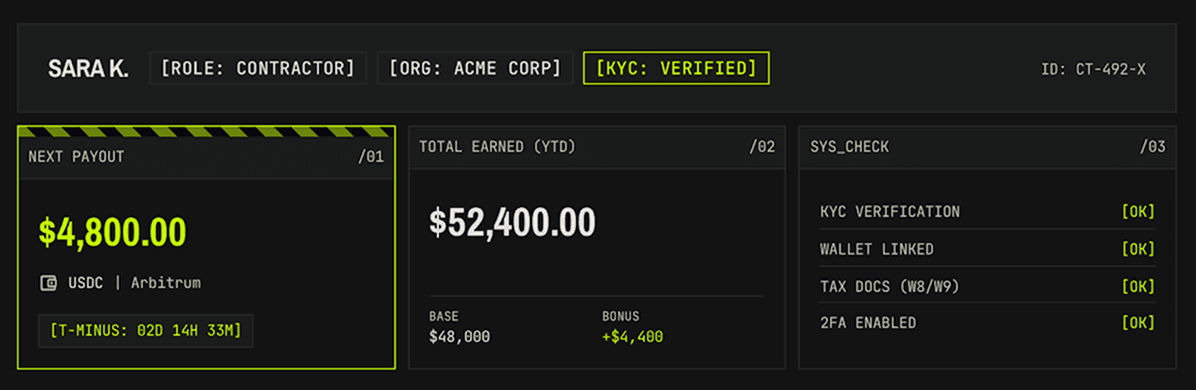
PayGrid contractor receiver portal showing payout status and readiness checks
A ledger-backed workflow system around on-chain transfers

Technical Architecture

The implementation is best understood as a workflow and ledger system wrapped around stablecoin transfers. The frontend handles the operator and contractor surfaces. A backend API owns workspace configuration, users, roles, payout runs, contractor records, route quotes, approval state, and audit events. PostgreSQL stores the durable ledger and workflow state; Redis supports queues, locks, and realtime updates; WebSockets push treasury, payout, and terminal events into the UI. On the chain side, connectors handle token balances, approvals, transfers, bridge quotes, transaction submission, and confirmation tracking. The system has to be idempotent: if a broadcast succeeds but a webhook or RPC response fails, PayGrid must be able to reconcile from chain state and continue the payout lifecycle without double-sending funds.
  • Durable Payout Ledger: Every deposit, bridge, payroll transfer, withdrawal, fee, and failed attempt should be recorded as an immutable operational event.
  • Idempotent Execution: Payout jobs need retry-safe state transitions so network failures do not duplicate payments.
  • Realtime Operations: Finance teams need live status for confirmations, route changes, failed transfers, low balances, and chain health.
  • Audit Surface: Approvals, configuration changes, automation runs, and transaction broadcasts should be queryable by workspace and payout run.
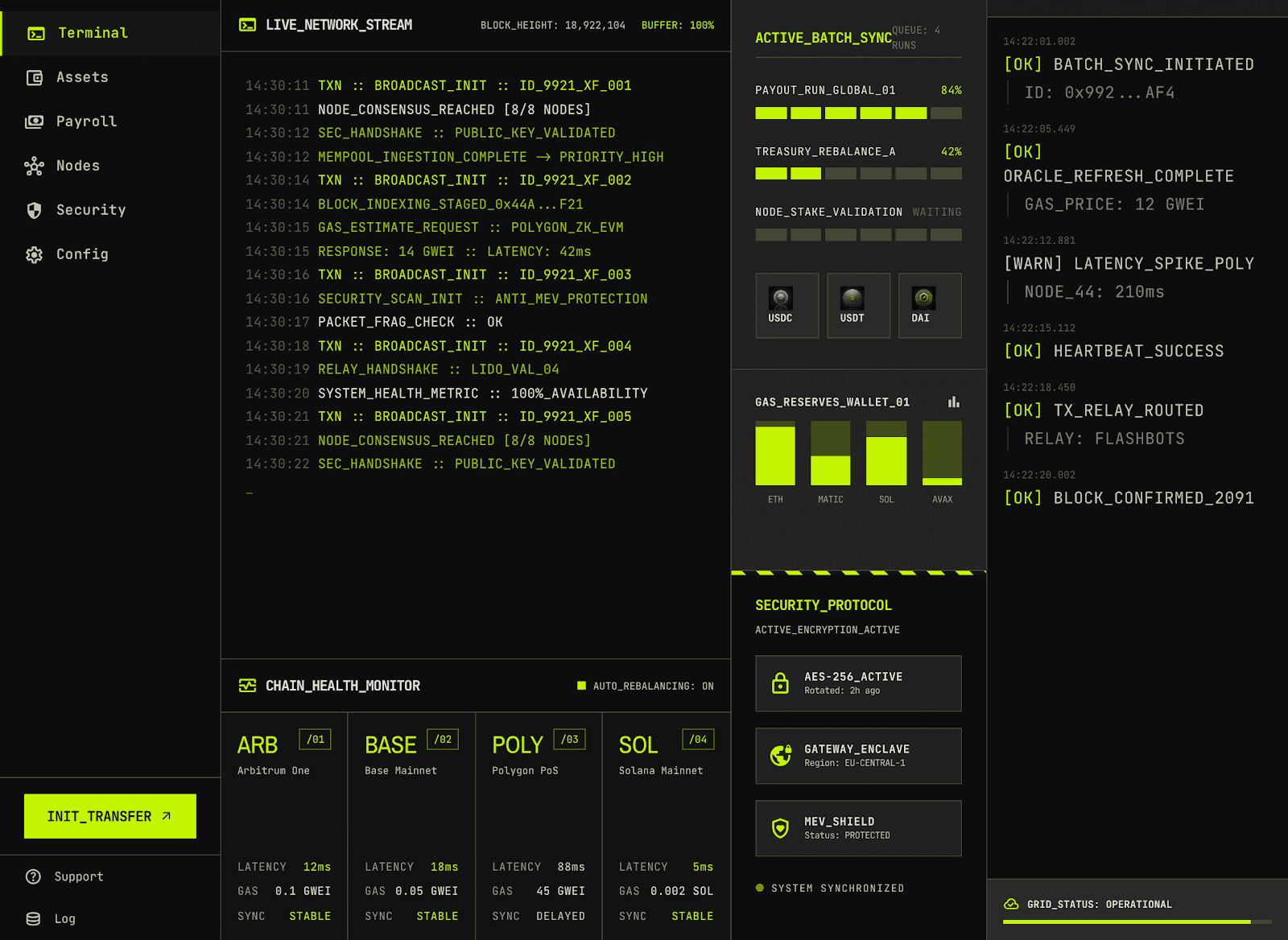
PayGrid terminal showing network stream, chain health, and operations feed
Metrics

Current Progress

PayGrid is being presented as an active build, not a finished public launch. The product work started in April 2026 and is currently focused on implementation, integration, and refinement. The case study therefore avoids fabricated usage metrics and focuses on the product architecture, operational controls, and core flows already designed.

Apr 2026
Started
Product strategy, architecture, and UI work began in April 2026.
In Build
Status
Frontend implementation and integration planning are in progress.
6
Core Workflows
Treasury, payout runs, routing, approvals, automation, and contractor portal.
Pending
Metrics
No production usage metrics are included until real data exists.
Project Gallery

Visual showcase

Gallery image 1
1 / 7
PayGrid - ChainScore Labs | ChainScore Labs